Filter By

CONJUGATION TARGETS
  • Antibody
LABEL/MODIFIER TYPE
  • 4FB
  • Biotin
  • Digoxigenin
  • HRP
  • HyNic
  • Oligonucleotide
  • R-PE
LOADING CAPACITY
  • ≥ 10 nmol/mg
  • ≥ 12 nmol/mg
  • ≥ 330 nmol/mL
DETECTION ENZYME(S)
  • Alkaline Phosphatase
  • HRP/AP
  • Peroxidase
TARGET SPECIES
  • biotin
  • Cat
  • Chicken
  • DIG
  • Goat
  • Guinea Pig
  • Hamster
  • Horse
  • Human
  • Human IgM
  • Human Kappa Chain
  • Human Lambda Chain
  • Lectin
  • Mouse
  • Multiplex (Mouse/Rabbit)
  • No antibody included
  • Rabbit
  • Rat
  • Sheep
  • Streptavidin
  • Universal (Mouse/Rabbit)
  • Universal (Mouse/Rabbit/Goat)
CHROMOGEN COLOR
  • Blue
  • Blue-Gray
  • Brown
  • Brown-Black
  • Gray-Black
  • Indigo
  • Magenta
  • Purple
  • Red
MOUNTING MEDIA TYPE
  • Aqueous (Hardening)
  • Aqueous (Non-Hardening)
  • Non-Aqueous (Permanent)
DETECTION TARGET
  • Avidin
  • Biotin
  • Digoxigenin/Digoxin (DIG)
  • Dinitrophenyl (DNP)
  • Fluorescein
  • Lectin
  • Streptavidin
CONJUGATE
  • Agarose
  • Alkaline Phosphatase
  • AMCA
  • Biotinylated
  • Cy3
  • Cy5
  • DyLight 488
  • DyLight 488/DyLight 594
  • DyLight 549
  • DyLight 594
  • DyLight 649
  • Fluorescein
  • Micropolymer AP
  • Micropolymer HRP
  • Micropolymer HRP/Micropolymer AP
  • Peroxidase
  • Rhodamine
  • Texas Red
  • Unconjugated
HOST SPECIES
  • Animal-Free
  • Bovine
  • Chicken
  • Goat
  • Horse
  • Mouse
  • Rabbit
  • Rat
  • Swine
BLOCKING ACTION
  • Autofluorescence
  • Endogenous Alkaline Phosphatase
  • Endogenous Biotin or Avidin/Streptavidin Binding Proteins
  • Endogenous Human Ig
  • Endogenous Mouse Ig
  • Endogenous Peroxidase
  • Endogenous Peroxidase/Alkaline Phosphatase (Blocking Action)
  • Non-Specific Protein Blocking
COUNTERSTAIN
  • DAPI
  • None
  • Phalloidin Rhodamine
  • Propidium Iodide
CELLULAR STAIN
  • Cytoplasm
  • Cytoskeleton
  • Glycoproteins
  • Nucleus
NEURONAL TRACER - DIRECTION OF TRANSPORT
  • Anterograde/Retrograde
TARGET FOR LABELING
  • Carbohydrate
  • DNA
  • Oligonucleotides
  • PNA
  • Protein
  • RNA
TAG/GROUP INCORPORATED
  • Thiol
MATRIX CONJUGATE
  • Lectins
  • Streptavidin
REQUIRED REACTIVE GROUP
  • 3' -OH group of DNA
  • 5 '-OH group of nucleic acid
  • Primary Amino Group
  • Thiol Group
SUGAR SPECIFICITY
  • [GlcNAc]1-3
  • Arabinose
  • Complex Structures
  • Core O-glycan
  • Fucose
  • Galactose
  • Glucose
  • Lactose
  • Mannose
  • N-Acetylgalactosamine
  • N-Acetylglucosamine
  • Sialic Acid
APPLICATIONS
  • Affinity Chromatography
  • Antibody Labeling
  • Antisense/RNAi
  • Aptamers
  • Blotting Applications
  • Cellular Imaging
  • ELISA
  • Elispot
  • Enrichment
  • Flow Cytometry
  • Glycobiology
  • Histology
  • Immunofluorescence
  • Immunohistochemistry
  • In situ hybridization
  • In Situ Proximity Ligation
  • Live cell imaging
  • Mitogenic Stimulation
  • Multiplexing
  • Neurobiology
  • Next-Generation Sequencing (NGS)
  • Photocrosslinking Studies
  • Super-Resolution Microscopy
FORMAT
  • Concentrate
  • Lyophilized
  • Ready-to-Use
DYE TYPE
  • AZDyes
  • Cyanine Dyes
  • Fluorescence Quenchers
  • MB Dyes
  • TAMRA Dyes
  • AQuora® Dyes
REACTIVE GROUP
  • Amine
  • Biotin
  • Dye Intermediates
  • Methyltetrazine
  • TCO
  • Tetrazine
  • Tyramide
  • Alkyne
  • Azide
  • DBCO
  • Hydrazide
  • Hydroxylamine
  • Maleimide
  • NHS-TFP-STP Esters
  • Non-activated fluorescent dyes
  • Picolyl Azide
ABSORPTION SPECTRA
  • 350 nm
  • 405 nm
  • 430 nm
  • 488 nm
  • 532 nm
  • 543 nm
  • 555 nm
  • 568 nm
  • 594 nm
  • 633 nm
  • 647 nm
  • 660 nm
  • 680 nm
  • 750 nm
  • Quenchers
  • Dye Intermediates
  • 800 nm
MOUNTING MEDIA COMPATIBILITY
  • Aqueous
  • Non-Aqueous

Categories

Biotin Azide Reagents

Cross-Linkers and DSPE Linkers | Click Chemistry: Biotin Azide Reagents

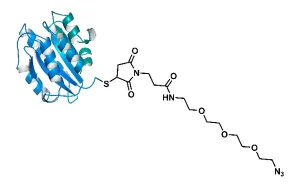
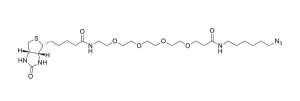
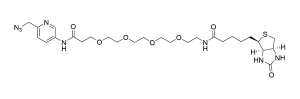
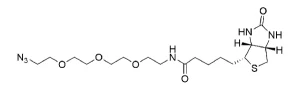
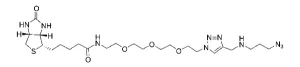
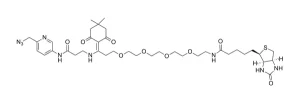
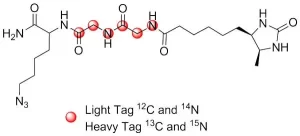
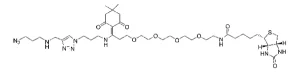
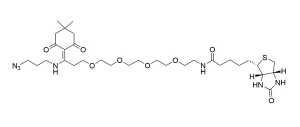
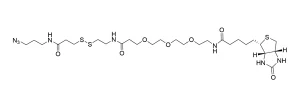
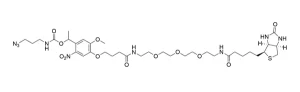
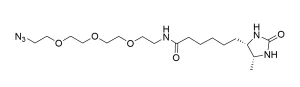
Biotin Azide Reagents are specialized compounds used in Click Chemistry, where they serve as highly reactive azide-functionalized biotin derivatives. These reagents enable efficient and selective conjugation to alkyne-functionalized biomolecules or surfaces through the copper-catalyzed azide-alkyne cycloaddition (CuAAC) reaction. Once conjugated, the biotin label allows for easy detection, purification, or isolation using avidin or streptavidin-based systems. Biotin azide reagents are commonly used in applications such as protein labeling, antibody conjugation, and the construction of biotinylated probes for use in molecular biology, diagnostics, and drug development.